

 RU
RU  PL
PL  DE
DE  RO
RO 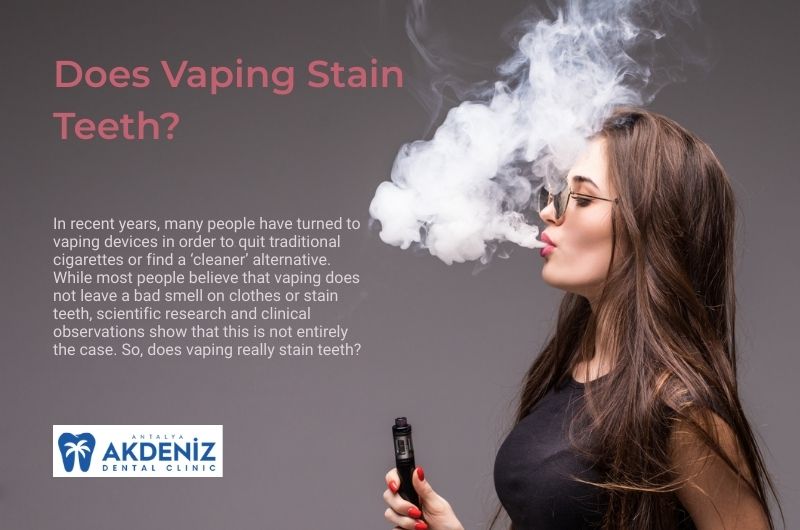
In recent years, many people have turned to vaping devices in order to quit traditional cigarettes or find a 'cleaner' alternative. While most people believe that vaping does not leave a bad smell on clothes or stain teeth, scientific research and clinical observations show that this is not entirely the case. So, does vaping really stain teeth?
What is vaping?
Vaping (the use of electronic cigarettes) is the act of inhaling an aerosol (commonly referred to as vapor) produced by heating a liquid (e-liquid) using a device.
The vaping process and its contents:
Mechanism of operation: Unlike traditional cigarettes, vaping devices do not burn tobacco, meaning that no combustion process takes place. Instead, a battery-powered heating element heats a solution called e-liquid until it becomes an aerosol.
E-liquid content: Vaping liquid typically consists of propylene glycol (PG), vegetable glycerine (VG), water, flavorings, and nicotine. Some users may use THC instead of nicotine; furthermore, while some products claim to be nicotine-free, this may not always be accurate.
Device Names: These systems are also referred to in the literature as Electronic Nicotine Delivery Systems, e-cigarettes, or vape pens.
Purpose of use: Many people use vaping as a means to quit smoking, believing it to be less harmful than traditional tobacco products, or to circumvent restrictions in non-smoking areas.
Risks involved: Vaping aerosol may contain chemicals such as formaldehyde and diacetyl, which is linked to lung disease, as well as heavy metals such as nickel, tin, and lead. Furthermore, nicotine, a highly addictive substance, can impair brain development.
Effects on oral health: Vaping has been linked to serious oral health problems such as dry mouth, receding gums, tooth decay, and softening of tooth enamel.
Why and how does vaping stain teeth?
While tar is the main culprit for staining in traditional cigarettes, the situation is slightly more complex with electronic cigarettes. Although there is no combustion in vaping devices, there are several key factors that cause staining:
Flavorings and colorings:
The thousands of different flavors found in e-liquids (especially menthol and tobacco flavors) cause more discoloration of tooth enamel than neutral flavors.
Nicotine oxidation:
Although nicotine is colorless initially, it turns yellowish when it comes into contact with air (oxidizes) and can cause discoloration by sticking to the tooth surface.
Heavy Metals and Pigments:
During the heating of the liquid, metal ions such as nickel, lead, tin, and chromium may mix into the aerosol from the heating coils inside the device. These metals and pigments in the e-liquid accumulate on the tooth surface, causing staining.
Are fillings at greater risk than natural teeth?
One of the most striking effects of vaping is its impact on dental fillings (composite resins) rather than natural tooth enamel. Research has demonstrated that aesthetic fillings are much more sensitive to vaping vapor than natural teeth:
- Visible color change: Some studies have found that the color change in composite fillings exposed to e-cigarette aerosol is almost the same as that caused by traditional cigarette smoke.
- Surface structure deterioration: E-liquid components can increase the roughness of the filling surface, making it easier for stains to adhere to the filling.
- Rapid effect: A patient who had no cavities for 35 years was observed to develop softening and staining of the tooth enamel just one year after quitting smoking and starting vaping.
Vaping and 'Dry Mouth'
Vaping not only leaves external stains but also facilitates staining by altering the chemistry of the mouth:
- Decreased enamel hardness: Flavorings in e-liquids can reduce the hardness of tooth enamel by 27%. Softened enamel traps pigments from food, drink, and vaping much more quickly.
- Bacterial magnet: The combination of vegetable glycerine and aromas increases bacteria adhesion to tooth enamel by 4 times and biofilm (plaque) formation by 2 times. This dense plaque layer absorbs coloring agents from external sources.
- Propylene glycol (PG) and dryness: PG draws water from the mouth, drying out the tissues (xerostomia). Saliva is the most important defense, naturally cleaning teeth and neutralizing acids; when saliva decreases, teeth become completely defenseless against staining and decay.
Effects of vaping on other restorative materials
Porcelain and ceramics:
Porcelain teeth are more resistant to staining; however, vaping can cause clinically noticeable (though generally less than with composite fillings) color changes in these materials as well.
Dentures (Acrylic):
Acrylic materials used in removable dentures may also discolor due to vaping, but this effect is lower than that caused by smoking.
Is vaping worse than smoking?
- Staining intensity: The tar in cigarettes causes much faster, darker, and more stubborn stains on teeth. From this perspective, vaping has less staining potential than smoking.
- Staining pattern: Cigarette stains are generally seen on the broad surfaces of the teeth, while vaping stains tend to concentrate along the gum line and at the junctions of the teeth.
- Overall oral health: Although vaping is considered less harmful to the lungs because it does not contain tar, the situation is different in terms of oral health. Dry mouth and acid erosion caused by sugar can increase the risk of gum disease and tooth decay. This leads to weakening of the tooth enamel in the long term, making it more vulnerable to all kinds of stains.
What can you do to prevent vaping-related tooth stains?
Although not as intense as smoking, vaping can definitely stain your teeth and especially your fillings. These products, marketed with the promise of 'stain-free teeth,' actually soften the tooth enamel and cause dry mouth, making your teeth more 'vulnerable' to stains. The most effective way to protect your smile is to avoid these products altogether.
To prevent and protect against vaping-related tooth stains, you can follow these steps:
- Drink plenty of water: The most effective way to prevent dry mouth is to drink plenty of water after vaping. This keeps your mouth moist and also cleans away some of the stain-causing particles.
- Brush regularly and correctly: Brush your teeth at least twice a day with fluoride toothpaste. Brushing after vaping is particularly beneficial. However, do not brush immediately. The oral environment after vaping may be slightly acidic; brushing immediately can damage tooth enamel. Ideally, wait about half an hour before brushing.
- Do not neglect to use dental floss: Dental floss is the best way to clean hard-to-reach plaque and debris between your teeth.
- Use mouthwash: Using an alcohol-free mouthwash that is good for dry mouth can provide extra benefits to your oral hygiene.
- Visit your dentist regularly: Seeing your dentist for a check-up every six months allows you to detect any stains or other problems early on. Your dentist can also easily remove surface stains with professional teeth cleaning.
- Pay attention to your liquid choice: if possible, choose liquids with a low nicotine content and no coloring (clear). Dark-colored, strongly flavored, and sweet liquids increase the risk of staining.
F.A.Q:
Does nicotine-free vaping (0 mg liquid) stain teeth?
Yes, there is still a possibility of staining. Even without nicotine, flavorings (especially dark-colored flavors such as vanilla and caramel) and sweeteners in the liquids can stain tooth enamel. It also causes dry mouth, which can lead to staining.
Do teeth whitening products remove vaping stains?
For surface stains, yes. Whitening strips or toothpastes sold in pharmacies can be effective on new stains. However, for long-standing stains that have penetrated the tooth enamel, the most effective solution is a professional teeth cleaning or in-office whitening treatment performed by your dentist.
Does vaping damage my gums?
Yes, it can. Nicotine constricts the blood vessels in the gums, reducing blood flow. This leads to the gums not being sufficiently nourished and their resistance to infection decreasing. Dry mouth also facilitates the accumulation of bacterial plaque, increasing the risk of gum inflammation (gingivitis) and gum disease (periodontitis).
Does vaping cause tooth decay?
Yes. There are two main reasons for this: Firstly, the flavorings in the liquids are converted into acid by bacteria in the mouth, which erodes tooth enamel. Secondly, the dry mouth caused by vaping eliminates the natural protective and cleansing effect of saliva, accelerating the formation of cavities.
Should I brush my teeth immediately after vaping?
No, brushing immediately is not a good idea. The oral environment may be temporarily slightly acidic after vaping. Brushing tooth enamel in an acidic environment can cause enamel erosion. It is recommended to wait at least 30 minutes before brushing. During this time, you can rinse your mouth with plenty of water.
Does vaping affect tartar?
Although it does not directly cause tartar, it has a significant indirect effect. Vaping accelerates plaque formation by causing dry mouth and disrupting the bacterial balance. If this plaque is not cleaned, it hardens over time by combining with minerals in saliva and turns into tartar.
Does vaping cause bad breath (halitosis)?
Yes, it has a significant effect. Nicotine and the mixtures it contains cause dry mouth. Dry mouth is an ideal environment for the growth of bacteria that cause bad odor. Furthermore, although the flavors used may temporarily mask the odor, the real problem is the bacterial odor that develops over time.
If I quit vaping, will the stains on my teeth disappear?
Yes, new stains will stop forming after you quit. However, existing stains will not disappear on their own. Regular brushing may reduce some surface stains over time, but professional cleaning (scaling and polishing) by your dentist is necessary for ingrained stains.
Which is worse for teeth: cigars, pipes, or vaping?
In general, cigars and pipes, being tobacco products and containing tar, have at least as much stain-forming potential as cigarettes, and in some cases even more. Vaping generally causes less staining compared to these traditional tobacco products. However, none of them are 'safe.'