

 RU
 PL
 DE
 RO
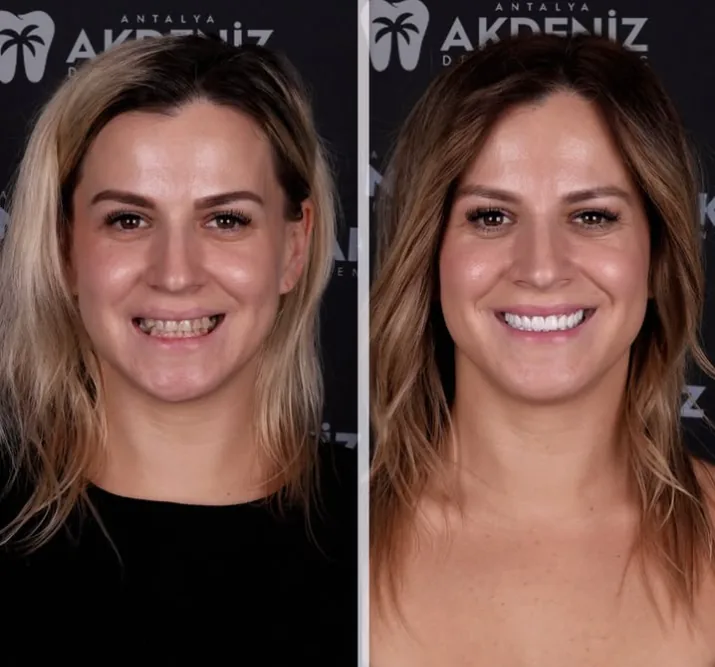
E-max veneers usually last 10 to 15 years, and many reach 20 years or more with good care. This applies equally to E-max veneers in Turkey, since patients treated in Antalya receive the same IPS e.max ceramic used by dentists across the UK and Europe. E-max veneers are made from lithium disilicate, a glass-ceramic that is both strong and translucent, and long-term clinical studies report survival rates above 95% after ten years. How long a set lasts in a particular mouth depends mainly on the bite, grinding habits, gum health and the quality of the bonding.
This guide explains what the research shows, which factors shorten or extend the life of E-max veneers, what happens to the teeth underneath, and how dentists maintain and replace them over the years.
E-max veneer lifespan at a glance
- Typical lifespan: 10 to 15 years, often 20 or more
- 10-year survival in studies: 95.5% to 97.4%
- Most common reasons for replacement: fracture and debonding, usually linked to grinding or bite overload
- Biggest single protective step: a night guard for patients who clench or grind
- Check-ups: every six months, with any dentist
In this guide
- What the research says about E-max veneer lifespan
- E-max veneers vs porcelain and composite veneers: lifespan compared
- What affects how long E-max veneers last
- What happens to the teeth under E-max veneers?
- What happens to E-max veneers after 15 to 20 years?
- Do E-max veneers last as long when done in Turkey?
- How to make E-max veneers last longer
- Can E-max veneers be repaired or replaced?
- Frequently asked questions
What the research says about E-max veneer lifespan
E-max veneers have been in clinical use for more than two decades, so their lifespan is no longer an estimate based on laboratory tests alone. Three studies give a clear picture.
A 2019 retrospective study in the International Journal of Prosthodontics followed 364 pressed lithium disilicate veneers in 41 patients for ten years. The 10-year survival rate was 97.4%. Complications affected only 1.64% of the veneers: fractures in 0.55% and debonding in 1.09%.
A 2021 systematic review in the Journal of Clinical Medicine combined 25 clinical studies and 6,500 porcelain veneers. The estimated 10-year survival rate was 95.5%. The review also found that non-feldspathic veneers, the group that includes E-max veneers, failed less often than traditional feldspathic porcelain veneers, and that most fractures and debonding occurred in the first years after fitting rather than late in the veneer’s life.
A 2024 retrospective study in Cureus examined 28 patients with E-max veneer cases, half of them fitted more than five years earlier. In 89.3% of cases the veneers showed no significant change; marginal staining was seen in 7.1% and debonding in 3.6%. The authors linked the problems they found mainly to poor oral hygiene, smoking and teeth grinding rather than to the ceramic itself.
Taken together, these results explain why dentists quote 10 to 15 years as a conservative range for E-max veneers: the material itself rarely fails, and most problems that do occur can be traced to the bite, oral hygiene or habits.
E-max veneers vs porcelain and composite veneers: lifespan compared
The material chosen sets the expected lifespan of a veneer. The table below compares the options most often discussed during a veneer consultation.
| Material | Typical lifespan | Main strength | Often chosen for |
|---|---|---|---|
| E-max veneers (lithium disilicate) | 10–15 years, often 20 or more | Strength combined with natural translucency | Front teeth and smile makeovers |
| Feldspathic porcelain veneers | 7–15 years | Very thin layers | Minimal changes to tooth shape |
| Composite veneers | 5–7 years | Quick to place and easy to repair | Small corrections and younger patients |
E-max veneers are pressed or milled from a single block of lithium disilicate, so each veneer has no weak layer between a core and a surface coating. This is one reason it resists chipping better than layered porcelain. Composite, by contrast, absorbs stains and wears gradually, which is why it needs polishing or renewal much sooner. Patients comparing ceramics in more detail can read the E-max veneers in Turkey treatment page or the guide to zirconium crowns.
Find out whether E-max veneers suit your teeth
Send a few photos of your smile for a free online assessment with Akdeniz Dental Clinic in Antalya. The dentist will advise which material, how many veneers and what treatment plan fit your case.
What affects how long E-max veneers last
Two patients can receive identical E-max veneers and see very different results after ten years. The difference almost always comes from the following factors.
Grinding and clenching (bruxism)
Grinding is the most common cause of early veneer fracture. Night-time clenching places forces on the front teeth many times stronger than normal chewing. Dentists check for signs of bruxism, such as flattened edges, worn enamel and tight jaw muscles, before treatment, and patients who grind are fitted with a night guard after their veneers are bonded.
Bite planning
A veneer that touches the opposite tooth too early or too hard takes repeated impact with every bite. Careful bite analysis and adjustment at the fitting appointment spread the load evenly. The 2021 review also found lower failure rates when the veneer covered the biting edge of the tooth, which is a design decision the dentist makes during planning.
Enamel and bonding quality
E-max veneers bond most strongly to enamel. Preparation that keeps the veneer margins within enamel gives a durable seal and lowers the risk of debonding. The bonding procedure itself, with acid etching of the ceramic, a silane primer and a resin cement cured under light, has to be carried out under dry, controlled conditions, which is why the experience of the dentist matters as much as the material.
Gum health and oral hygiene
The ceramic cannot decay, but the natural tooth along the edge of the veneer can. Plaque left at the gum line leads to inflammation, gum recession and, in time, decay at the margin. Daily brushing and flossing protect the seal between the veneer and the tooth.
Habits and diet
Biting nails, pens or ice, opening packets with the teeth and chewing very hard foods with the front teeth can chip any ceramic. Smoking does not stain the ceramic surface, but it stains the margins and harms the gums that support the veneers.
Laboratory work
The fit of the veneer at its edges affects how well it seals. Veneers made in a laboratory that works directly with the treating dentist can be checked and adjusted before bonding. At Akdeniz Dental Clinic, the veneers are produced in the clinic’s own Akdeniz Dental Lab, so shade, shape and fit are confirmed in person between the dentist and the technician.
What happens to the teeth under E-max veneers?
The teeth under E-max veneers remain living teeth with their own nerve and blood supply. To make room for the veneer, the dentist reshapes a thin layer of enamel from the front surface, commonly around 0.3 to 0.5 mm, roughly the thickness of a fingernail. In some cases, minimal-preparation veneers need even less.
Once the veneer is bonded, the tooth and the ceramic behave as a single unit. The tooth beneath can still respond to temperature for a short time after treatment, and this sensitivity usually settles within a few days. Over the long term, the main task is to keep the edge where the veneer meets the tooth clean, since this is the only area where decay can begin.
Because the enamel has been reshaped, a tooth that has received a veneer is kept covered for life, either by the same veneer or by a new one when replacement is due. Patients unsure whether a veneer or a crown suits a particular tooth can read the guide to veneers vs crowns.
What happens to E-max veneers after 15 to 20 years?
Well-maintained E-max veneers often look and function well beyond 15 years. The ceramic does not fade or lose its gloss in the way composite does. The changes seen after many years usually come from the mouth around the veneers rather than from the veneers themselves:
- The gums can recede slightly with age, exposing a thin line of natural tooth at the edge of the veneer.
- The natural teeth next to the veneers may darken over time, so the shades no longer match as closely.
- The bonding cement at the margins can pick up light staining.
Some of these changes can be corrected by professional polishing or by whitening the neighbouring teeth. When the appearance or the fit of a veneer has changed noticeably, the dentist replaces it. Because the tooth was shaped during the first treatment, replacement usually needs very little further preparation.
Do E-max veneers last as long when done in Turkey?
Yes. Lifespan depends on the material, the laboratory work, the bite planning and the patient’s care at home, not on the country where the veneers are fitted. IPS e.max is produced by the same manufacturer, Ivoclar, and the same lithium disilicate ceramic is used in Antalya, London and Berlin.
What matters is how the treatment is planned. At Akdeniz Dental Clinic, E-max veneer treatment starts with a digital scan and smile design, so the shape and length of each veneer are planned around the patient’s face and bite before any tooth is prepared. The veneers are then made in the clinic’s own laboratory, and the full treatment usually takes 5 to 7 days, depending on the scope of treatment.
After returning home, patients can continue to use their E-max veneers for many years by having their routine dental care carried out at a local dental clinic.
Spread the Cost of Your E-max Veneers
Planning E-max veneers in Antalya? Learn how you can finance your treatment through Ideal4Finance with tailored monthly repayment options.
How to make E-max veneers last longer
Most of what decides the lifespan of E-max veneers happens in the years after treatment. Dentists give patients the following advice:
- Wear a night guard if you grind or clench. This is the single most effective step for preventing fractures.
- Brush twice a day with a soft toothbrush and a non-abrasive toothpaste. Highly abrasive whitening pastes can dull the glaze over time.
- Clean between the teeth every day with floss or interdental brushes to keep the gum line healthy.
- Avoid using the front teeth as tools. Ice, pens, nails, bottle caps and packaging should be kept away from veneers.
- Cut hard foods into smaller pieces and chew them with the back teeth.
- Wear a sports mouthguard for contact sports.
- Attend check-ups and professional cleaning every six months. Early signs of wear or gum changes are far easier to manage than late ones.
Can E-max veneers be repaired or replaced?
The answer depends on the type of damage:
| Problem | Usual solution |
|---|---|
| Small chip on the edge | Polishing, or a small composite repair |
| Veneer comes off in one piece | Cleaning and re-bonding of the same veneer |
| Crack or larger fracture | Replacement with a new veneer |
| Staining at the margin | Professional polishing; replacement if the stain is under the veneer |
| Gum recession with a visible edge | Replacement, sometimes combined with gum treatment |
If a veneer comes off, it should be kept in a small box or a soft cloth and brought to the dentist. Household glue should never be used, as it damages both the veneer and the tooth.
Signs that an E-max veneer needs attention
- A chip, crack or rough edge
- A veneer that feels loose or moves when pressed
- A dark line where the veneer meets the gum
- Sensitivity or discomfort around one tooth
- Bleeding or swollen gums around the veneers
- A colour that no longer matches the neighbouring teeth
Patients who notice any of these signs can send photos or X-rays to the clinic for an online examination, including patients whose veneers were fitted at another clinic.
Planning E-max veneers in Antalya, Turkey
E-max veneers are among the longest-lasting cosmetic treatments in dentistry when they are planned well and looked after. Patients considering treatment usually want to know three more things: the cost, how many veneers they need and what the result will look like.
- Treatment steps, costs and packages are explained on the E-max veneers in Antalya page.
- Full smile makeovers combining several treatments are covered on the Hollywood smile page.
- Choosing a natural shade is explained in the tooth shade guide.
- Real results can be seen in the before and after gallery.
Frequently asked questions
Plan long-lasting E-max veneers in Antalya
Share your smile photos on WhatsApp and receive a personal treatment plan, the number of veneers you need and a price for your case.