

 RU
 PL
 DE
 RO
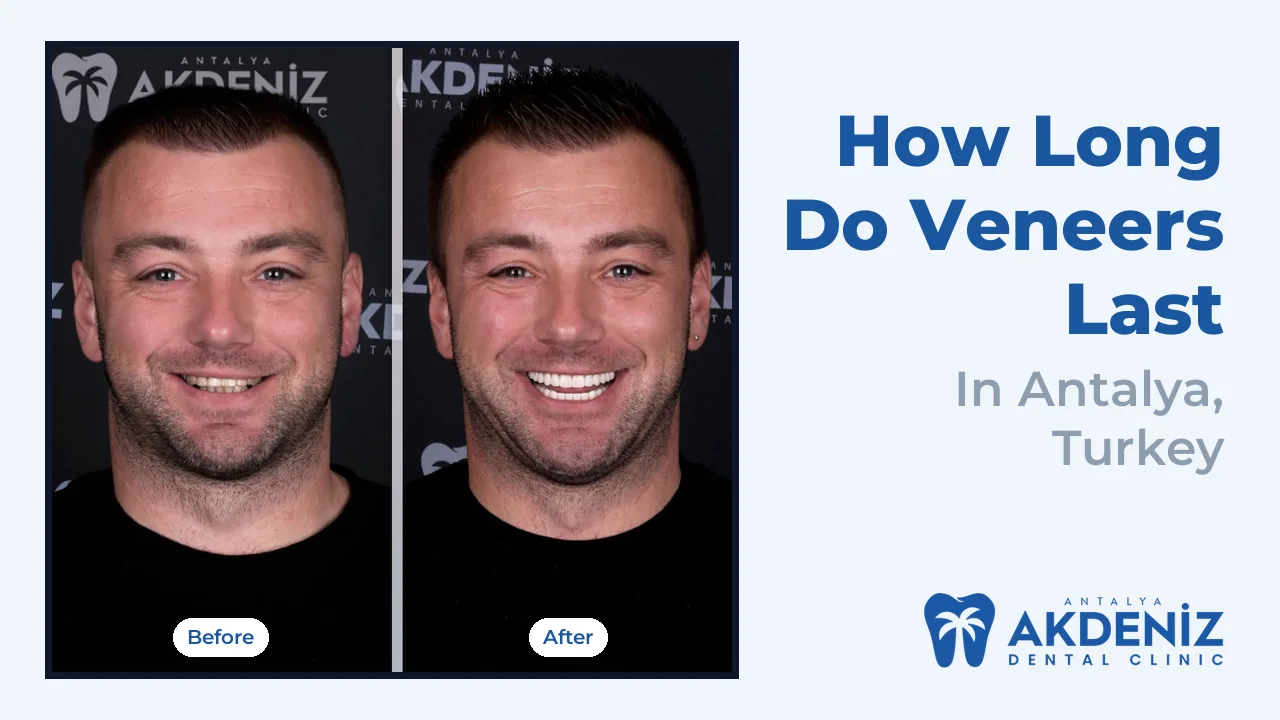
Porcelain and E-max veneers in Turkey usually last 7 to 15 years, and with good care they can reach 20. Composite veneers sit lower, at around 5 to 7 years.
How long do Turkey teeth and veneers in Turkey last?
Material sets the starting point. Here’s how the main options compare for patients choosing veneers in Antalya:
| Material | Typical lifespan | Often chosen for |
|---|---|---|
| E-max (lithium disilicate) | 7–15 years, up to 20 with good care | Natural translucency plus strength |
| Feldspathic porcelain | 7–15 years, up to 20 with good care | Very thin veneers |
| Zirconia | 7–15 years | Strength under heavy chewing forces |
| Composite | 5–7 years | Smaller changes and easy repairs |
These are averages, not promises. Your bite and your daily habits move the number.
What do long-term studies say about veneers?
The numbers are reassuring.
A 2021 systematic review in the Journal of Clinical Medicine pulled together 25 studies and 6,500 porcelain veneers. Its estimate: 95.5% still in service after 10 years. (The authors do ask readers to treat that figure with some care, since the studies differ.)
Two more findings stand out. Fracture and debonding were the most common complications, and both tended to appear in the first years, so an early check-up is well worth booking. And non-feldspathic veneers, the group E-max belongs to, performed better than feldspathic ones.
Why many patients choose E-max veneers in Turkey
Strength and looks, in one thin shell.
E-max veneers in Turkey are made from lithium disilicate, a ceramic that lets light through much like natural enamel — so the smile doesn’t look flat under bright light or in photos. Because the shell is so thin, the dentist can usually keep more of the tooth too.
Lab work counts as well. Akdeniz Dental Clinic has its own lab, Akdeniz Dental Lab, which lets the dentist and the technician settle shade and shape together, face to face.
Does every smile need E-max? No. Some cases suit zirconia; others only need composite. The examination decides that.
Spread the Cost of Your Veneers in Turkey
Planning veneers in Antalya? Learn how you can finance your treatment through Ideal4Finance with tailored monthly repayment options.
What helps veneers in Antalya last longer?
A good part of the work happens before you leave the chair: careful bite planning, and bonding to enamel wherever possible, since enamel gives the strongest hold.
The rest is up to you, and it’s simple enough:
- Wear a night guard if you grind. Probably the biggest single thing you can do for your veneers.
- Clean the gum line properly. The veneer itself won’t decay; the tooth behind it still can. Floss or interdental brushes, every day.
- Let your teeth be teeth. Ice, pens, bottle tops — leave them alone.
- Keep your check-ups. Every six months.
What happens to veneers in Turkey after 10 years?
Usually? Not much.
Plenty of well-kept veneers still look and work beautifully at the 10-year mark; nothing switches off on a tenth birthday. The gum line may shift a little, or an edge may pick up a light stain, and a dentist can often polish or tweak those without replacing anything.
Signs your veneers are ready for replacing
- A chip or crack
- A veneer that feels loose or clicks
- A dark line where the veneer meets the gum
- New sensitivity around one tooth
- A colour that no longer matches the teeth beside it
If something feels a bit off, get it looked at early. Small problems are far simpler to sort out.
Can veneers be replaced in Turkey?
Yes, and it’s routine work. Patients who had veneers elsewhere years ago often come to Antalya for a fresh set, sometimes with a different material or a more natural shade.
What happens to the tooth underneath?
The dentist takes off the old veneer, examines the tooth and prepares the surface. Then the lab makes the new one and it’s bonded in place. The tooth was already shaped the first time, so it usually needs very little extra preparation.
If a tooth has changed a lot since then, say with a large filling or a root canal, a crown may protect it better. This guide to veneers vs crowns explains the difference.
Do veneers done in Turkey last as long as veneers in the UK?
Fair question. And the answer is simple: lifespan follows the material, the lab work, the bite planning and your care at home. Long-term studies track materials and techniques, not passports.
E-max is the same lithium disilicate ceramic whether it’s fitted in Antalya or in London. So veneers in Turkey, planned well and looked after well, can be expected to reach the same 7 to 15 years.
Looking after your veneers after leaving Antalya
Your veneers fly home with you, and so does the routine.
Expect a few days of getting used to the new feel; most patients settle quickly. Then book a check-up with your local dentist within the first year and keep going every six months, because any dentist can clean around veneers and check them.
Something feels different? Share your photos or X-rays with the clinic for an online examination.